
ChatGPT released 6.2 Astra & Sol
Hi everyone, I'm Frank, an indie developer.
On November 17, 2026, OpenAI released GPT-6.2 Astra and GPT-6.2 Sol. Both emphasize the same idea: better results on harder work, with fewer output tokens.
What shipped
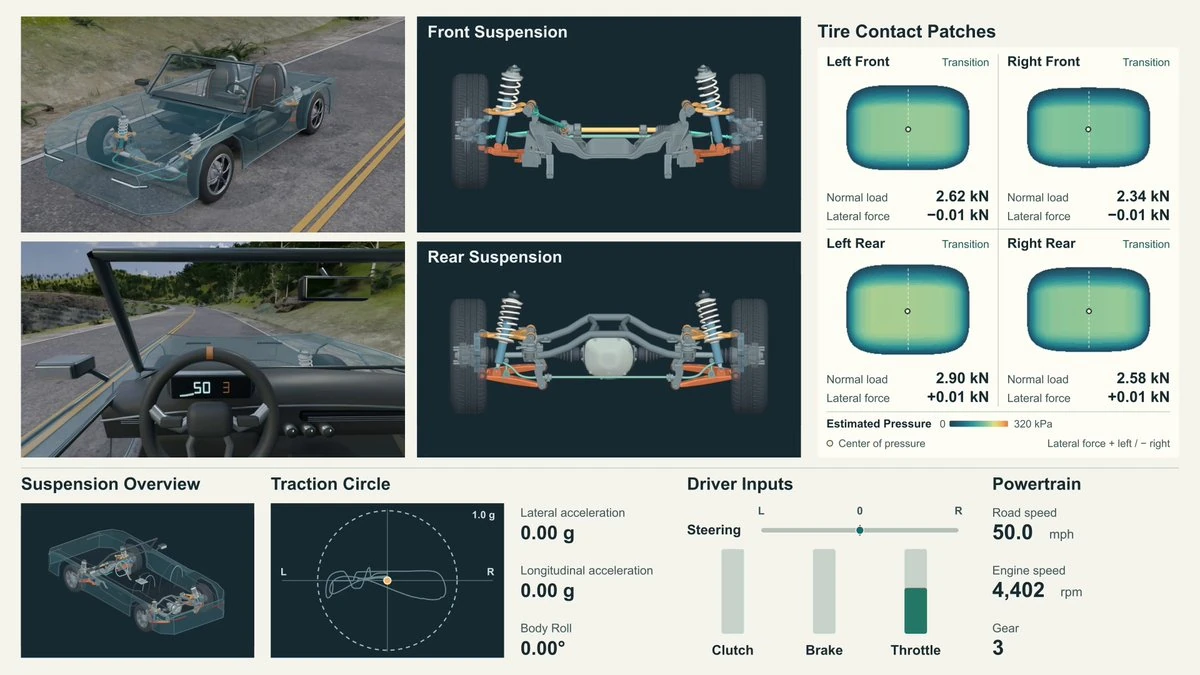
Officially, Astra is the frontier model for the hardest professional work: slides, spreadsheets, and documents stay closer to your templates and industry conventions, and the code—plus front-end work like websites, games, and 3D—comes out cleaner. Sol is the efficient general-purpose model for everyday work, including multi-step agents and day-to-day coding and writing. OpenAI's announcement also says many employees already use Sol as their default for both technical and non-technical tasks.
Who can use it, and what it costs
Both models are available in ChatGPT Work, Codex, and the API, under the ids gpt-6.2-astra and gpt-6.2-sol. In ChatGPT, you need to open Work; they are not being added to regular Chat. Standard short-context prices, per million tokens, are $8 input and $40 output for Astra, and $2 input and $10 output for Sol. Astra is clearly the more expensive of the two; Sol is the better fit when you want to keep everyday costs down. Inputs longer than 272K tokens are billed at a long-context surcharge; see the pricing page.
What the evaluations say
Artificial Analysis
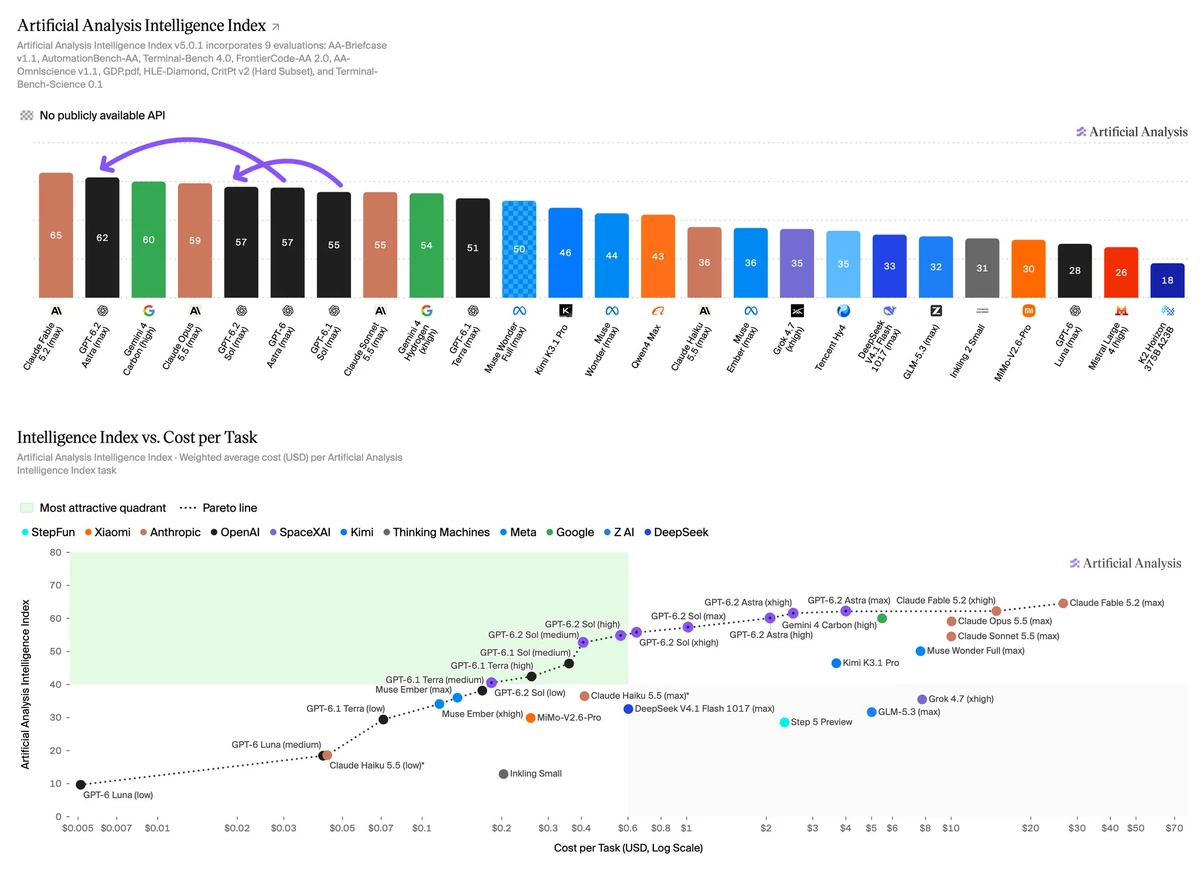
Artificial Analysis scores GPT-6.2 Astra at 62 on the Intelligence Index for both Max and Xhigh, and Sol at 57 on Max. Cost per task is $4.00 for Astra Max, $2.52 for Astra Xhigh, and $1.01 for Sol Max. On the Coding Agent Index (Codex harness, max), though, Astra is flat against GPT-6 Astra, and Sol is 3 points below GPT-6.1 Sol.
Arena
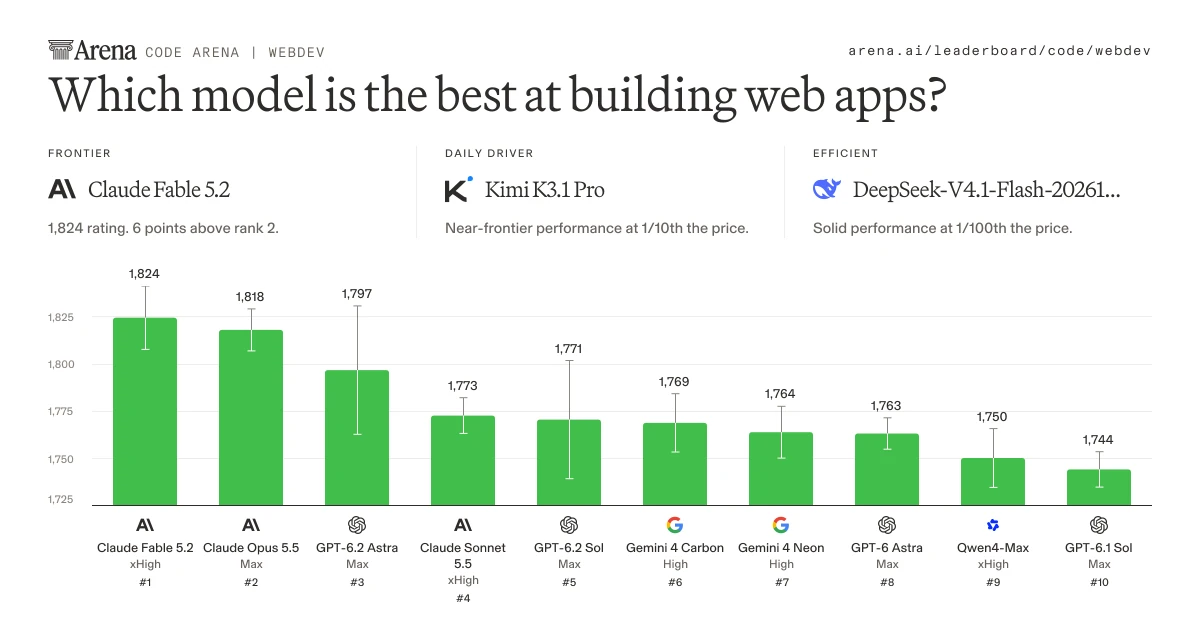
On the November 18, 2026 pages (the day after launch): GPT-6.2 Astra (Max) is #3 on WebDev and Sol (Max) is #5; on the Coding Index, Astra (Max) is #3 and Sol (Max) is #9.
Highlights from the replies
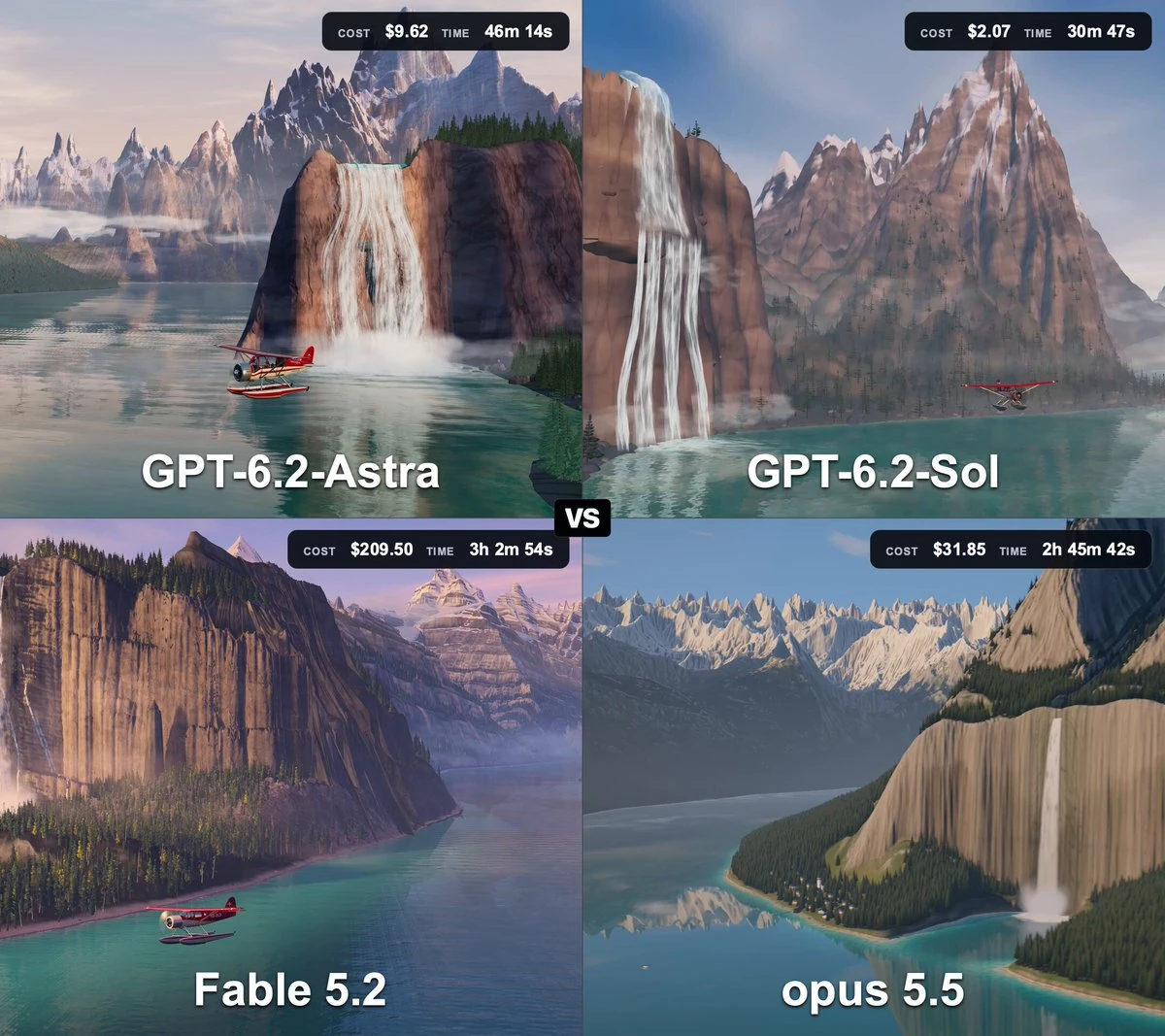
The hands-on posts that got the most attention after launch were visual and 3D tests. EnvolDev ran the same prompt across four models (969 likes, 103 replies, about 172,000 views): GPT-6.2 Astra cost $9.62 and took 46 minutes 14 seconds; Sol was $2.07 and 30 minutes 47 seconds; Fable 5.2 was $209.50 and 3 hours 02 minutes 54 seconds; Opus 5.5 was $31.85 and 2 hours 45 minutes 42 seconds. He found Astra's plane detail especially strong, at about 1/22 the cost of Fable 5.2 and nearly 4 times as fast; Sol finished for $2.07, about 1/100 the cost of Fable 5.2. The next day he ran a lighthouse follow-up: the two OpenAI models were stronger on lighthouse detail, while Fable 5.2 and Opus 5.5 did better on the ocean; Sol cost $1.47 and took 25 minutes 04 seconds, versus $71.09 and 2 hours 00 minutes 30 seconds for Fable 5.2. These are single visual tasks, not something you can generalize to every kind of work.
Same-prompt comparisons
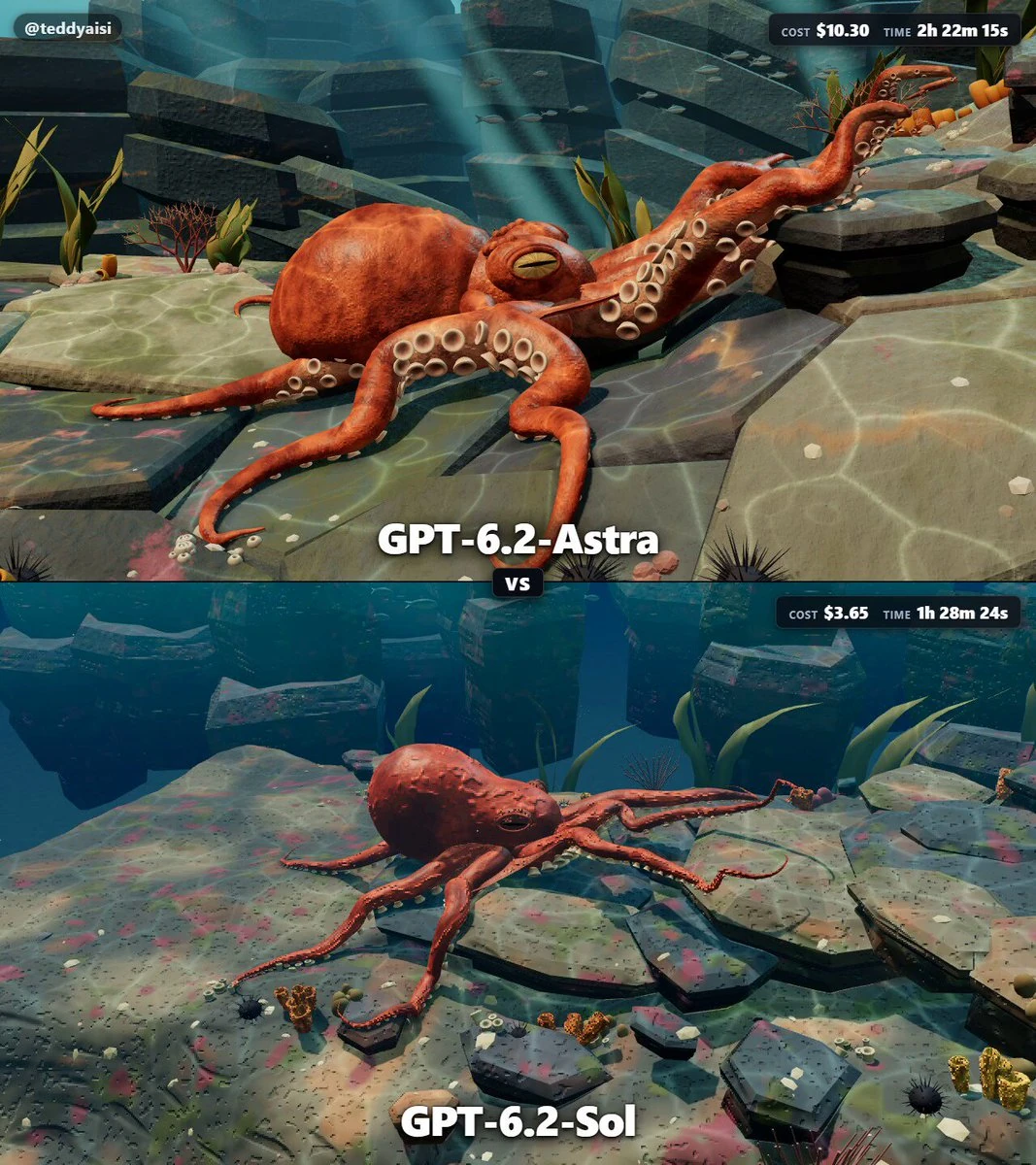
This hands-on from teddyaisi got 89 likes and about 7,561 views. He asks whether you would pay $10.30 for Astra's detail, or run Sol at nearly a third of the cost. A day earlier, the Chinese-language user ai_funss compared pelican-on-a-bicycle runs at High; the original post, translated below, went up on November 16, before the official launch, and engagement was modest (9 likes, 18 replies):
GPT-6.2-Astra vs GPT-6.2-Sol, a pelican-on-a-bicycle comparison
Time:
GPT-6.2-Astra-High (image 1): 8m42s
GPT-6.2-Sol-High (image 2): 4m54sI actually think 6.2 Sol looks a bit better, and it also took less time and costs less
On the OpenAI forum, someone compared the two on DigBench at High: both 6.2 models cleared the tasks, and a cost-weighted view favored Sol. Other users reported that the models were still rolling out and weren't visible in their clients yet. Some writing-focused threads noted that this launch is aimed at professional documents, not at being the next fiction model; a community moderator suggested GPT-6.1 Terra for prose and novels—that's a community tip, not an official ban.
How to choose
Don't treat the official pitch, the leaderboards, and a single visual demo as the same kind of evidence. The announcement is about professional-work positioning; AA and Arena measure specific benchmarks and votes; most community demos are one-off 3D or web tasks.
- For everyday coding, changing a request, or running a multi-step workflow, when quota and the bill matter: start with GPT-6.2 Sol. Official FrontierCode results and the AA Intelligence Index both show it can often come close to more expensive models.
- For the hardest research, science-terminal work, legal or finance deliverables, complex 3D, and computer use: official messaging puts GPT-6.2 Astra in that tier. AA and Arena's WebDev and Coding boards also rank Astra higher; on AA, though, Astra's Max and Xhigh Intelligence Index scores are the same, and Max is slower and more expensive.
- Pick the reasoning tier first, then the model. The drop at Low on AA is sharp; don't ignore the fact that on the Coding Agent Index, Astra is flat and Sol regresses.
- Run a round of your own real tasks, especially long documents and safety-sensitive workflows. OpenAI tightened high-risk cybersecurity assistance for these models and published a system card.