
Fable 5.2 or Opus 5.5
Hi everyone, I'm Frank, an indie developer.
When I'm writing code day to day, I like using Opus 5.5. But when the work is complex code planning, I think Fable 5.2's ability is, without a doubt, in a league of its own. I just don't use Fable that often, because of the price. These are both models I especially like.
Anthropic released Claude Fable 5.2 on November 9, 2026 (the morning of November 10, Singapore time). In less than an hour, @theo had already put words to what a lot of people were feeling: "It's been under an hour and I'm already struggling with 'should I use Opus 5.5 or Fable 5.2?'" When I checked, the post had about 467,000 impressions and 4,580 likes.
This is a comparison piece, with a fixed structure: community voices first, then evals I could check against a source, from Arena, Anthropic, and Artificial Analysis. The community material is user opinion and one-off tests, not official conclusions.
What People Are Saying
I mostly searched X for "Fable 5.2 vs Opus 5.5" and a few variants in English, Chinese, Japanese, and other languages, then looked for Reddit as a supplement. What follows are the higher-engagement voices that a lot of people seemed to agree with, across English, Chinese, Japanese, Portuguese, and more. They are user opinions, not reproducible evals.
The first consensus in the thread is actually pretty plain: Fable 5.2 is stronger, but that does not mean you should use it for everything, every day. @rohit3a put it bluntly: "No, Opus 5.5 is not suddenly obsolete because Fable 5.2 is here. Opus 5.5 is just as good at coding, Fable 5.2 is just a better boss." His suggestion is to let Fable 5.2 (Medium) do the orchestration and hand the execution to Opus 5.5. That points in the same direction as Anthropic's own Advisor / Orchestrator guidance, but it is still his experience.
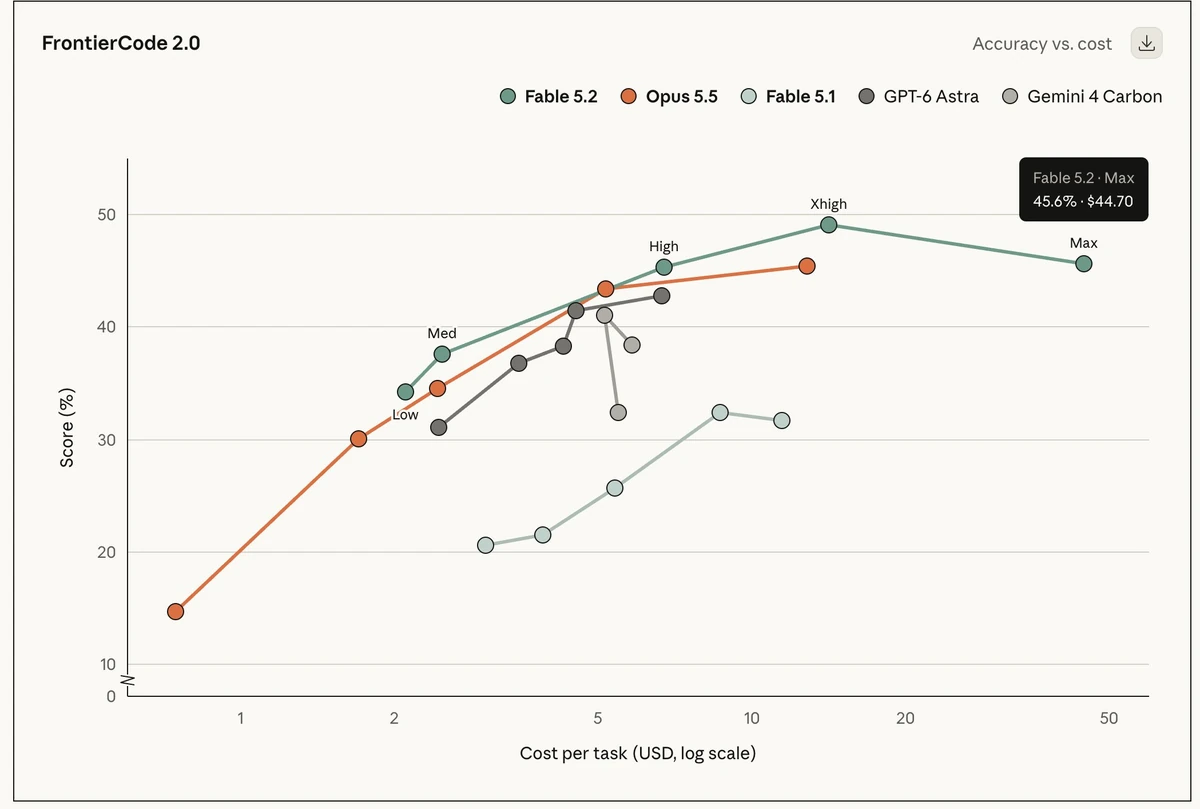
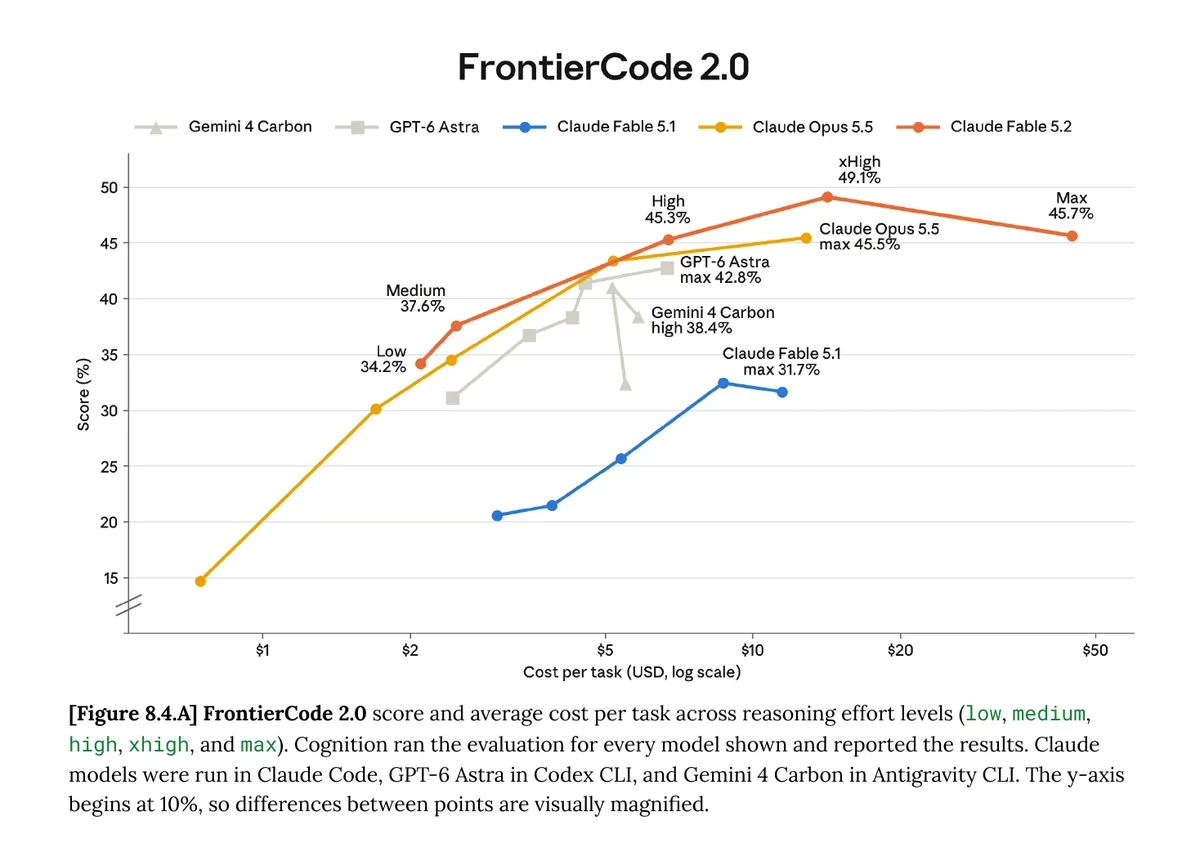
On launch day, @Yuchenj_UW attached the official FrontierCode chart and wrote just one line: "Don't use Fable 5.2 Max man." You can read the chart as saying Fable 5.2 peaks around Xhigh, then the score falls at Max while the cost per task jumps. That is his reading of an official chart, not a separate bench.
Coding and Creative Work
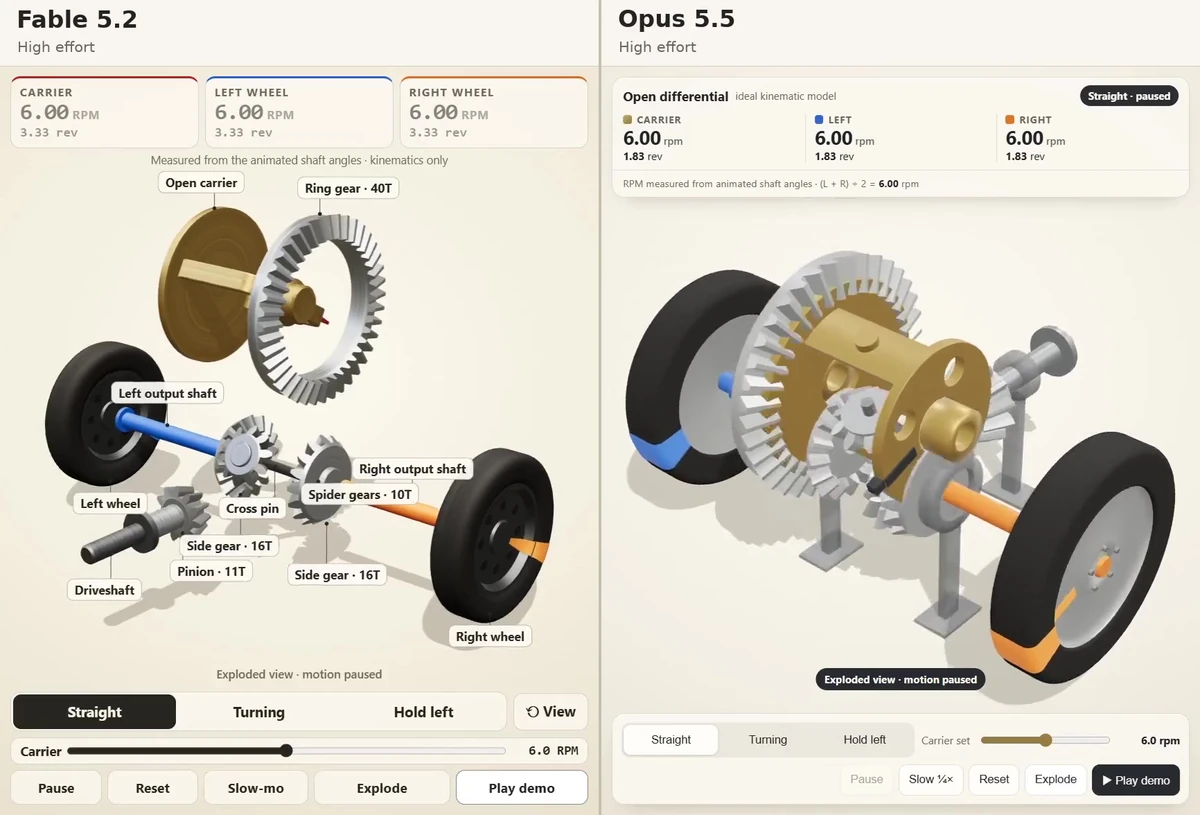
Coding and visualization comparisons were the most common posts, and the conclusions do not line up neatly.
@ivanainai's side-by-side demo is a fair sample of one reaction: both sides can turn a complex mechanical structure into an interactive page, and the Fable side is denser with labels and breakdowns. He did not declare a winner in the text; he just posted the result. @luccacerf in Sao Paulo also posted a games-with-AI comparison (about 44,000 impressions). @patch_gg compared Blender sculpting and scene building.
Another cluster of posts cares more about "same prompt, how much did it cost, and how long did it take." @Bhavani_00007 tested both on the same rocket-launch scene: Fable 5.2 cost $23.45 and took 32 minutes; Opus 5.5 cost $10.35 and took 24 minutes. She called Fable's detailing and realism "incredible," but she had expected better efficiency, or at least pricing closer to Fable 5.1. The post had about 47,000 impressions; the Arabic-language account @EngMoElgaraihy later restated the same numbers.
@notjazii used the same prompt with both models on xhigh and said "results came out kinda same": Opus took about 15 minutes and $8.2, Fable about 60 minutes and $18. "for the price i think opus is worth it but the amount of details fable added are just crazy." @EnvolDev compared plane builds on the same Alpine Gold prompt: Fable 5.2 at Extra High "built the best plane by far," but it cost $209.50 and about 3 hours, versus $31.85 and about 2 hours 46 minutes for Opus 5.5. These are one-off, non-reproducible user tests.
Some people found Fable faster. @ITangieff compared how the models recreated a video of the Sun: Fable took 10 minutes, Opus took 24, and he left the "which did it better" question to readers. @IndependentEco wrote, "Fable 5.2 is faster than Opus 5.5 so far in my testing." Those early, launch-day impressions do not contradict the longer, more expensive xhigh tests above. Change the effort tier, and both the wait and the bill can move a lot.
A high-engagement post that was not a head-to-head came from Japanese user @akakuma0219, who asked Fable 5.2 for previz motion using only three words: "jogging, an all-out sprint, and an ultra-high-speed dash." He said the unnatural parts of the 3D animation were hardly noticeable. The post had about 119,000 impressions and 1,389 likes. It shows how excited the community is about Fable's motion and 3D work, but it did not include an Opus control.
Writing and marketing comparisons were rarer. @ENowoslawski put Fable 5.2, Opus 5.5, and Haiku 5.5 into the same outbound campaign test. Engagement was lower than the coding posts, and it is a useful reminder: the community's current "consensus" is mostly about code and visuals, not copy.
What It Costs
Price is the second-loudest thread in the community discussion, and the easiest one to state clearly. The official list prices themselves are not in dispute: Fable 5.2 is $8 input / $40 output per million tokens, exactly twice Opus 5.5 ($4 / $20), and 20% below Fable 5.1's $10 / $50.
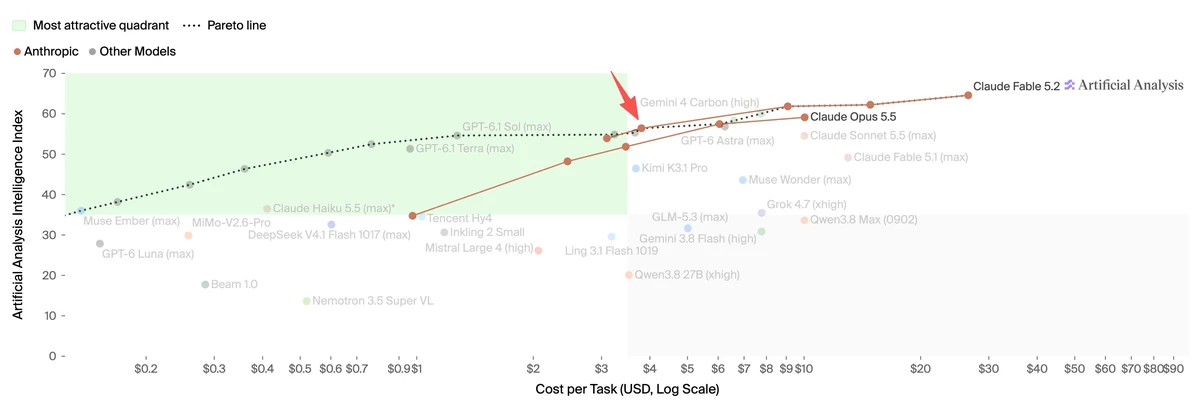
What people are actually arguing about is whether to change the effort tier or change the model. The most-engaged Chinese-language post came from @MinLiBuilds. Drawing on Artificial Analysis scores, he wrote: "Opus 5.5 only needs to keep xhigh; the other tiers can be retired. If you use Opus 5.5 high day to day, you can switch straight to Fable 5.2 low: the score goes from 52 to 54, and the cost drops about 10%. If you use Opus 5.5 xhigh day to day, you can switch to Fable 5.2 medium: the score is only one point apart (57 vs 56), the cost drops about 37%, and the time is cut nearly in half." That is his reading of AA's data, not an official Anthropic recommendation.
Japanese developer @ynishi2015 (about 87,000 impressions and 790 likes) was more operational: if you replace high-effort Opus with low-effort Fable, results per dollar improve a bit, and results per unit of time improve a lot. If you are on a subscription, use Fable 5.2 up to the weekly limit, then fall back to Opus 5.5 when the Fable quota runs out. In his view, if you pay as you go, there is no reason to run Opus at high effort. Portuguese-language user @gabrielbuzziv echoed the official line that "Fable 5.2 high delivers what Opus 5.5 max does, at about half the price."
Others think the return on the Max tier is getting worse. @analogalok cited AA's numbers: Fable 5.2's Intelligence Index is 65 versus 59 for Opus 5.5, but the cost is $26.54 per task versus $10.04, and the time is 46.4 minutes versus 25.1 — "you are paying +164% more." (On the Artificial Analysis page I checked, the times are 46.8 minutes versus 25.2. The direction matches; I am using the official page for the minutes and seconds.)
How Arena Ranks Them
The numbers below come from the official Arena pages, checked on November 13, 2026. Each board's own published date is listed with the section. I tried to screenshot the boards with a headless browser, but Chrome in this environment could not write a stable screenshot, so this section uses official figures I could verify in text, with no extra chart.
WebDev Arena (official page, page date November 11, 2026, 997,838 votes, 159 models):
- 1st: Claude Fable 5.2 (xHigh), 1838 ± 21, 1,215 votes
- 2nd: Claude Opus 5.5 (Max), 1815 ± 12, 4,208 votes
Both have a rank range of 1–2, and Fable still has far fewer votes, so the gap should not be read as locked in.
Agent Arena (official page, page date November 11, 2026, 2,927,721 sessions, 64 models):
- 1st: Claude Fable 5.2 (Max), net improvement 30.48% ± 3.07%, 7,841 sessions; median cost per task $7.48, median time 16.4 minutes
- 2nd: Claude Opus 5.5 (Max), net improvement 19.51% ± 2.04%, 14,561 sessions; median cost per task $5.68, median time 14.4 minutes
On Praise vs Complaint, Fable 5.2 (Max) is at 74.41% ± 12.70%, and Opus 5.5 (Max) is at 40.72% ± 7.59%. That is an official Arena metric, not a survey I ran.
Text Arena (official page, page date November 11, 2026, 9,122,174 votes, 422 models): I did not find Claude Fable 5.2 on the full board. Claude Opus 5.5 (High) was 4th, at 1507 ± 6, with 15,793 votes. On text head-to-heads, you cannot treat "Fable has already passed Opus" as an Arena fact.
Vision Arena (official page, page date November 8, 2026, 1,567,670 votes, 167 models): that date is still before Fable 5.2's public launch, and the board also has no Fable 5.2. At the time, Claude Opus 5.5 (High) was 6th, at 1295 ± 10, with 4,789 votes; first place was the earlier Claude Fable 5 (High), at 1309 ± 7. Fable 5.2's vision-arena results are not something to cite yet.
Official Scores
Anthropic is explicit in the launch post: Fable and Mythos are for the hardest, most open-ended technical work; for most coding and knowledge work, start with Opus 5.5, then step up to Fable if you need to, or down to Sonnet or Haiku. Fable can also be an Advisor or Orchestrator. @ClaudeDevs later posted the same model-choice guide.
Unless noted otherwise, the official scores below were run with safeguards on, at each model's highest available effort. The full method is in the system card.
Fable 5.2 leads on:
- FrontierCode 2.0: 49.1% at Xhigh, the highest score Anthropic reports for a released model, ahead of Opus 5.5's 45.5%. At High, it is almost tied with Opus's best (45.3% vs 45.5%), at about half the cost per task. The system card notes that Max-tier Fable scored 45.7%, but 22 of 660 attempts timed out; if timeouts count as zero, that falls to 44.4%, below Opus 5.5. That lines up with the community line, "don't use Fable Max."
- FrontierSWE v2: 69.9% vs 62.3% for Opus 5.5.
- Terminal-Bench-Science 0.1: 74.6% vs 58.7%.
- WANDR (relaxed): 82.1% vs 72.3%. Anthropic says Medium already matches Opus's top score, at about 40% of the cost per task.
- OSWorld 2.1 (offline set, partial): 89.3% vs 87.2%.
- Humanity's Last Exam (with tools): 74.2% vs 67.7%.
- Remote Labor Index: 41.3% vs 21.3% at High effort.
- Chartography (no tools): 73.4% vs 64.4% at the highest tier in the table.
- RoboDojo Sim (internal, Max): 64.9% vs 39.4%.
- AutomationBench: 51.4% vs 42.5%. On the same table, Gemini 4 Carbon is ahead of Fable, at 53.9%.
Not every official number favors Fable. On AA-Briefcase v1.1, Fable's rubric score is 66.1%, above Opus's 61.2%; but Opus 5.5's Elo is 1800, above Fable's 1785. On knowledge and document work, official data does not write Opus off.
Anthropic also reports that, in the same setup of about 1,000 agents, Fable 5.2 finished a formalization of Fermat's Last Theorem in 30 hours; Opus 5.5 had completed 26% at 18 hours and had barely moved by hour 30. That is an official demo, not a third-party reproduction.
What AA Says
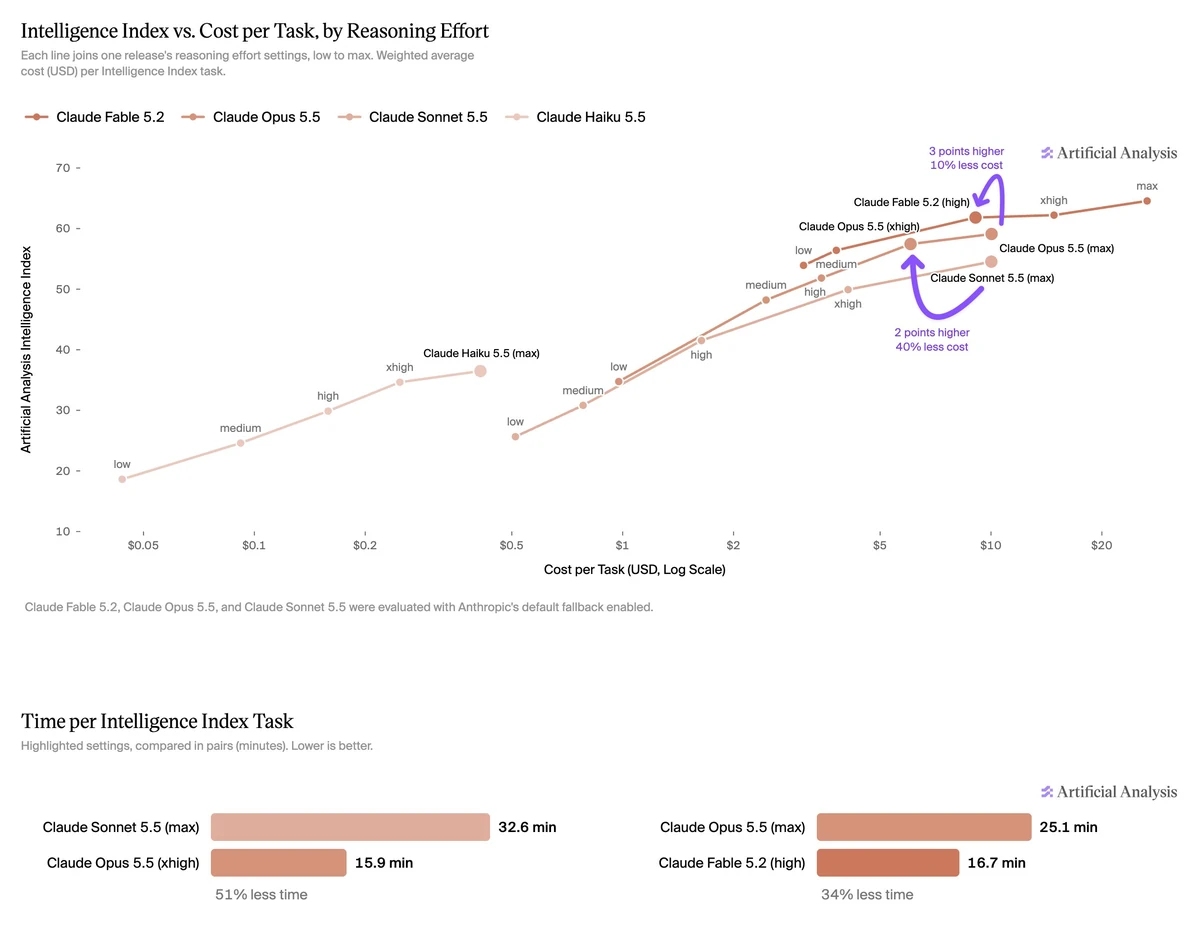
In its November 12 official post, Artificial Analysis wrote that, in the current Claude lineup, moving up a model tier often beats maxing out effort on the same model. The Max vs Max comparison it gives (Default Fallback; figures as I found them on the comparison page) is:
- Intelligence Index: Fable 5.2 at 65, Opus 5.5 at 59
- Cost per task: $26.54 vs $10.04
- Time per task: 46.8 minutes vs 25.2 minutes
- Output speed: 98 tok/s vs 115 tok/s
- Context window: 1 million tokens for both
- Input / output list price: $8 / $40 vs $4 / $20
On the individual benches, Fable leads on AutomationBench-AA (76.4% vs 69.5%), FrontierCode-AA 2.0 (48.8% vs 46.4%), AA-Omniscience v1.1 (67 vs 48), HLE-Diamond (80.2% vs 67.9%), and Terminal-Bench-Science 0.1 (73.3% vs 59.0%). Terminal-Bench 4.0 is a tie, both at 59.6%. On AA-Briefcase v1.1 Elo, Opus is at 1801 and Fable at 1785; GDP.pdf also slightly favors Opus (26.2% vs 24.2%). That matches the direction of Anthropic's own Briefcase table.
Another comparison the community cites a lot is Fable 5.2 High vs Opus 5.5 Max: AA gives an Intelligence Index of 62 vs 59, $9.08 vs $10.04 per task, and 16.9 vs 25.2 minutes. In other words, on AA's suite, Fable does not have to go to Max: High already beats Opus Max, and it is cheaper and faster. That is still an Artificial Analysis eval, not a guarantee for your local workflow.
When to Use Which
Put the community views next to the official numbers, and the comparison is already fairly clear:
- Everyday coding, edits, knowledge work, and well-specified tasks: start with Opus 5.5. That is Anthropic's official advice, and it is also the conclusion of a number of high-engagement posts — Opus did not become obsolete the day Fable shipped.
- Fuzzy requirements, long-running work, orchestrating many agents, or a task where Opus at a high tier is still not enough: step up to Fable 5.2. Both the community and AA more often recommend Medium / High, not Max.
- Change the effort tier first, then the model: official guidance and AA both stress this. For the same hard task, Fable High is often a better fit than Opus Max; Fable Max can cost more and still not score higher.
- Bills and quotas: by the token, Fable is about twice Opus. If you are on a subscription, you can do what @ynishi2015 suggested: spend the weekly Fable quota on the hardest work, then fall back to Opus.
In one line: Opus 5.5 is the default, Fable 5.2 is the boost. Look at how hard the task is, how long you can wait, and what the bill can bear, then decide whether you need that extra tier.