
Hydrogen or Sonnet 5.5
Hi everyone, I'm Frank, an indie developer.
If you've been following the latest frontiers from the major AI labs, you'll remember how sharply Google surged in this field in 2025 — and then, somehow, how it spent all of 2026 a year behind. With the year almost over, they've finally decided to make a push.
Google released Gemini 4 Hydrogen on November 12, 2026 (API id gemini-4-hydrogen). It is positioned for fast execution, everyday coding, and agentic workflows; in the same generation, Carbon and Argon sit further up the stack. A lot of people are comparing it with Claude Sonnet 5.5, which shipped on September 28, 2026 (claude-sonnet-5-5).
What People Are Saying
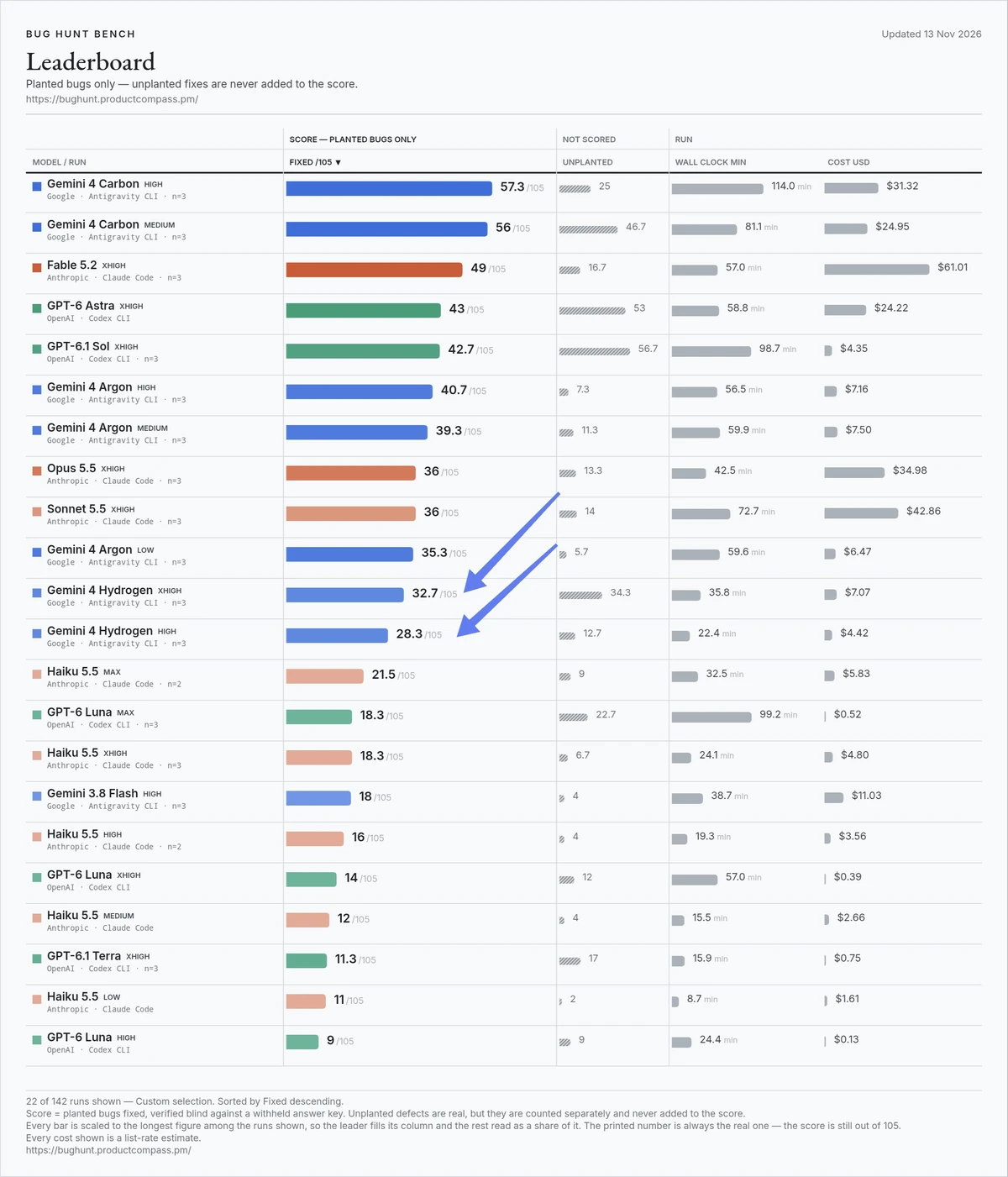
@PawelHuryn replanted 105 bugs in two real repositories and had the models find and fix them. His conclusion: Gemini 4 Hydrogen (xhigh) is "just behind Sonnet 5.5 (xhigh)." You can read off the chart (planted bugs only): Sonnet 5.5 (xhigh) 36 / 105, 72.7 minutes, $42.86; Hydrogen (xhigh) 32.7 / 105, 35.8 minutes, $7.07; Hydrogen (high) 28.3 / 105, 22.4 minutes, $4.42. This is a third-party test. Hydrogen ran through Antigravity CLI and Sonnet through Claude Code, so these are not official scores from the same harness.
@ai_funss put it this way (excerpt, translated):
In this mid-tier, I think only Gemini 4 Hydrogen really delivers.
Claude Sonnet 5.5 — Thunder thinking is just too slow GPT-6.1-Terra — dumb; the prejudice in people's minds is a mountain Gemini 4 Hydrogen — fast and good
Coding and Creative Work

@Haleeeemahh ran a 3D koi-pond comparison on the same prompt and asked, "who did it better?" In the still, both sides produced an interactive Jelly Koi Pond; the Sonnet side is denser with lilies, a frog, and captions, and the Hydrogen side is plainer. The author did not declare a winner.
@VulKan42069 had Hydrogen (Extra) go up against Sonnet 5.5 (High) on a Homing Javelin game. The gist: on output quality, Hydrogen cannot beat Sonnet 5.5; but for ordinary people, students, and teachers, especially on the $20 plan, Hydrogen is a better fit and is less likely to burn through the quota. These are one-off tests, and the effort tiers are not the same.
An Interactive Robot
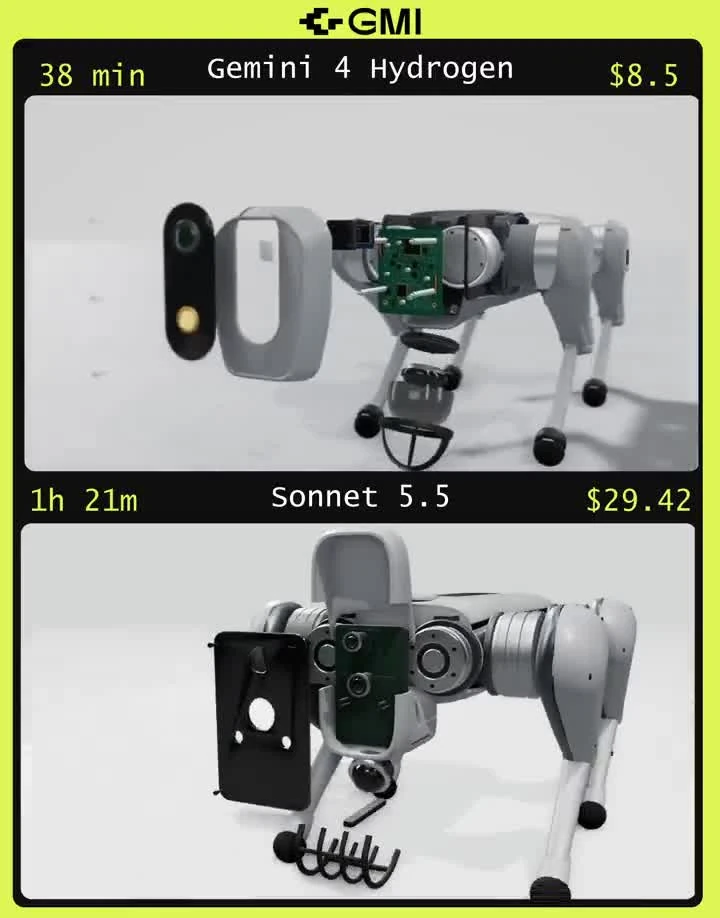
@gmi_cloud built an interactive robot in Three.js. The conclusion: "sonnet is still better." The on-screen labels say Hydrogen took 38 minutes and $8.5; Sonnet took 1 hour 21 minutes and $29.42.
Official Scores
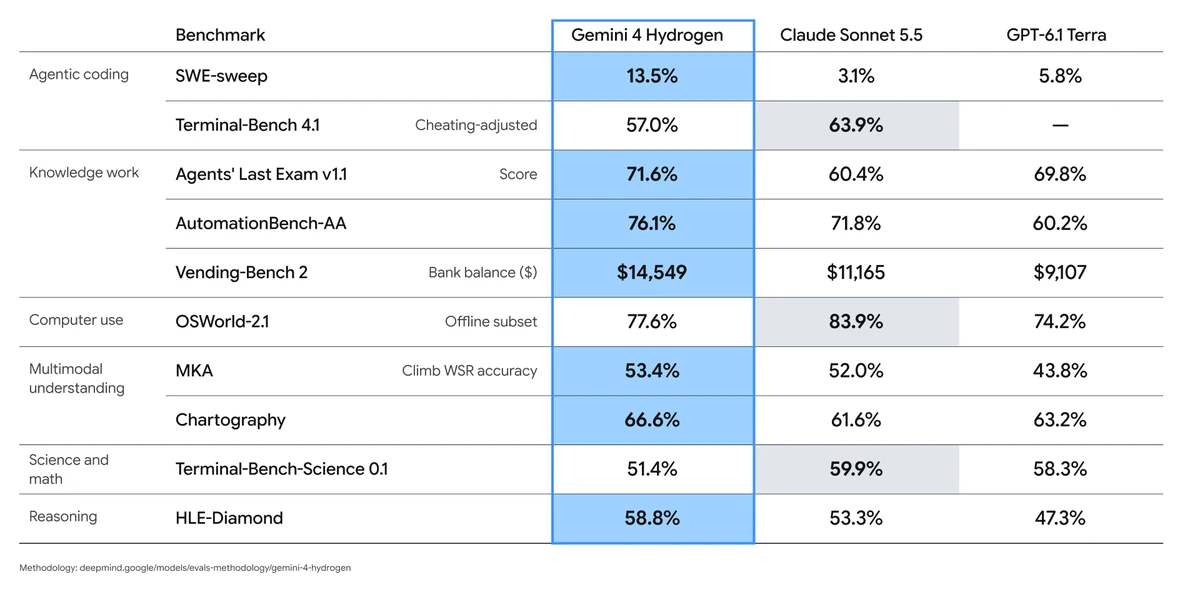
Google describes Hydrogen in the launch post and the DeepMind model card. The thinking tiers are LOW, MEDIUM, HIGH (the default), and XHIGH. On the 10-benchmark table in the post, highlighted cells give Hydrogen a 7–3 record against Sonnet 5.5. The evaluation notes show that the harnesses and thinking tiers are not fully matched. On Terminal-Bench 4.1, for example, Hydrogen was run at high (not xhigh) by Google; Sonnet's score comes from the public leaderboard. On SWE-sweep, Hydrogen used Antigravity-CLI and Sonnet used the public leaderboard.
The clearer gaps: SWE-sweep is 13.5% vs 3.1%, Agents' Last Exam v1.1 is 71.6% vs 60.4%, AutomationBench-AA is 76.1% vs 71.8%, and HLE-Diamond is 58.8% vs 53.3%. Sonnet leads on three items: Terminal-Bench 4.1 (63.9% vs 57.0%), OSWorld-2.1 offline (83.9% vs 77.6%), and Terminal-Bench-Science 0.1 (59.9% vs 51.4%). The official table uses Terminal-Bench 4.1; AA later uses 4.0. Do not mix the two.
List prices: Hydrogen is $1.50 input / $7.50 output per million tokens; Sonnet 5.5 is $2 / $10. Both have a 1 million token context window.
How Arena Ranks Them
The numbers below come from the official Arena site. The Text, Agent, and WebDev pages are all dated November 11, before Hydrogen's November 12 launch, so they should not be read as live rankings. Hydrogen is marked Preliminary on each board, and it is often compared with a different Sonnet effort tier.
Text Arena (official page): Gemini 4 Hydrogen (High) is 15th, 1490 ± 9, Preliminary, 4,741 votes; Claude Sonnet 5.5 (xHigh) is 47th, 1473 ± 6, 14,355 votes.
WebDev Arena (official page): Sonnet 5.5 (xHigh) is 3rd, 1772 ± 10; Sonnet 5.5 (High) is 9th, 1715 ± 8; Hydrogen (High) is 10th, 1704 ± 14, Preliminary, 1,997 votes.
Agent Arena (official page): Sonnet 5.5 (Max) is 4th, net improvement 16.07% ± 2.81%, median cost $3.48, median time 18.1 minutes; Hydrogen (High, Preliminary) is 5th, 14.80% ± 2.23%, median $1.53, 5.4 minutes; Sonnet 5.5 (High) is 14th, 8.02% ± 1.93%. Against Max, Hydrogen High is slightly behind, but cheaper and faster; against High, Hydrogen High's net improvement is higher.
What AA Says
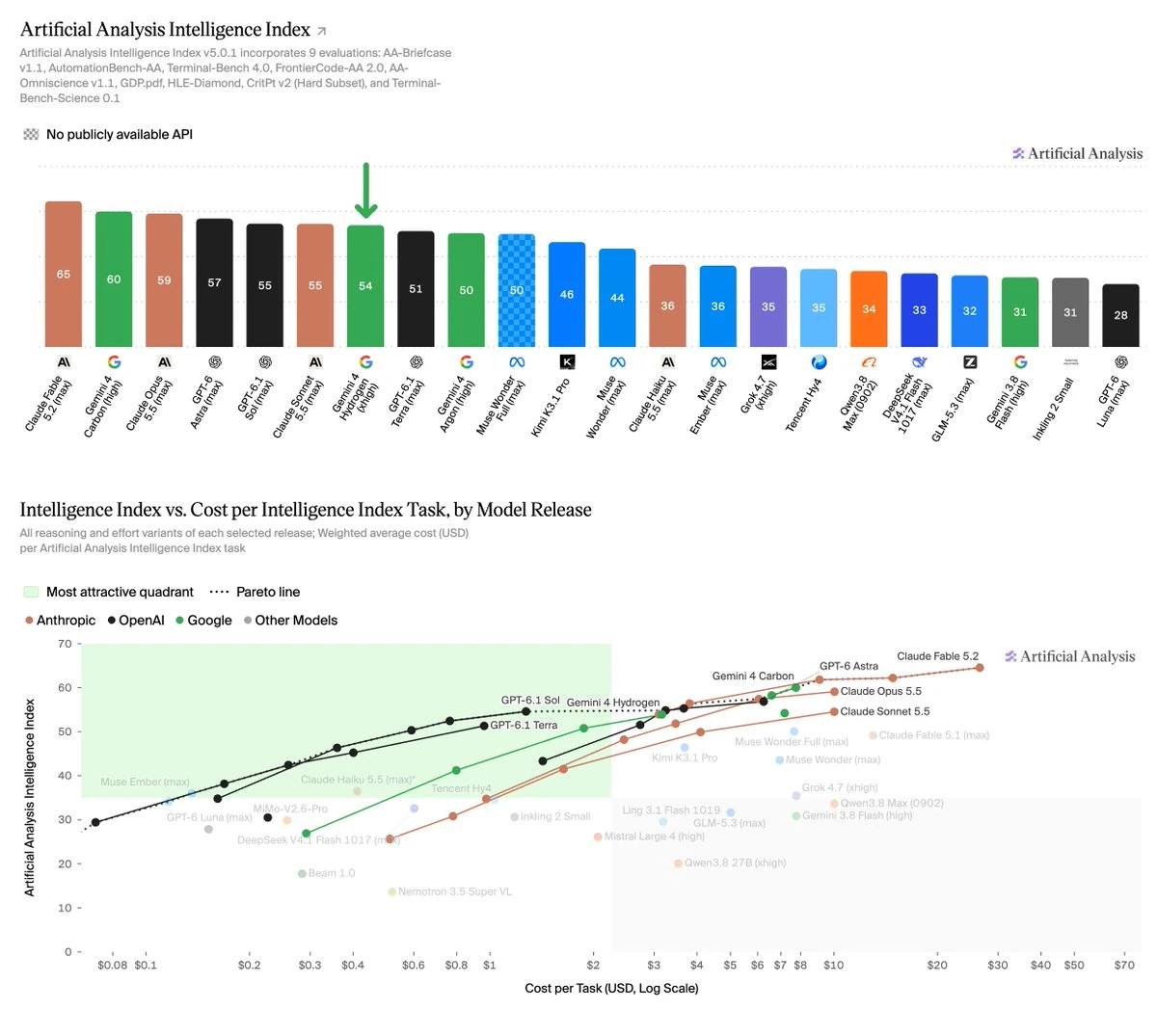
On Artificial Analysis (Intelligence Index v5.0.1), Sonnet 5.5 (Max) is 55, Hydrogen (Xhigh) is 54, and Hydrogen (High) is 51. Cost per task at Max vs Xhigh is $10.02 vs $3.16; time per task is 33.0 vs 14.7 minutes. Time and speed are rolling 5-day averages and may drift later.
That does not mean Hydrogen is cheaper at every matching effort tier. At High vs High, Sonnet High is $1.64 per task and Hydrogen High is $1.87.
On the individual benches, Hydrogen (Xhigh) leads on AutomationBench-AA, HLE-Diamond, and several others; Sonnet (Max) leads on Terminal-Bench 4.0 (63.6% vs 53.5%), FrontierCode-AA 2.0, and AA-Briefcase Elo. A few numbers also disagree with Google's official table, so check the source and the version when you quote them. AA also notes that Hydrogen accepts text, image, speech, and video input, while Sonnet accepts text and image.
When to Use Which
- If you care more about speed and cost, or you are doing everyday coding and agent workflows: start with Gemini 4 Hydrogen. That is where Google has positioned it, and on AA, Xhigh is only one point behind Sonnet Max, at lower cost and time. In this sample, some users also called it fast and good, or a better fit for the $20 plan.
- If you care more about front-end and interactive polish, or about terminal and computer-use work: in this sample, Sonnet 5.5 comes up more often. It also leads on WebDev Arena and on official Terminal-Bench 4.1 and OSWorld-2.1. That is only the direction in these examples; it is not a reason to assume Sonnet is more solid on every hard task.
- Look at the effort tier first, then the model. Do not subtract scores across different tiers, and a matching tier does not automatically mean a lower bill.
These are public evals and a limited set of user tests. Try it on your own work first, then decide which tier to run.