

A guide to the Gemini 4 models, if you've been confused too
Hi everyone, I'm Frank, an indie developer.
Over the past month or so, Google has split Gemini 4 into a string of element names: first Argon, then Carbon, Hydrogen, and Neon. The API IDs follow the same pattern, such as gemini-4-hydrogen. One thing to get straight first: the elements are official product names, not a capability ladder ranked by atomic number. Hydrogen is element 1, but it's the fast everyday model; Argon is element 18, yet it was the first Gemini 4 to ship, in October. Google also hasn't publicly explained why it chose element names.
Remember these three sentences, then add Argon, and the lineup is much easier to keep straight:
- Hydrogen is fast. It's built for everyday coding and agent execution, and it has the broadest access.
- Officially, Neon "balances depth and efficiency." It's meant for complex but high-frequency engineering, knowledge-work, and science tasks.
- Carbon is the one Google calls its strongest model. It spends more time thinking, and it's meant for the hardest, longer-running work.
Argon has not been discontinued. It was the first Gemini 4 model, generally available worldwide on October 13, 2026. Google now describes it as faster than Carbon, and as using fewer tokens per turn; it can still handle most software engineering and knowledge work. The four models are easy to mix up partly because the specs look so similar: they all share a 1 million-token unified context window, they all accept text, images, audio, video, and PDFs, and they all support Search grounding, code execution, function calling, computer use, and structured outputs. What actually separates them is speed, how long they "think" by default, unit price, and who can use them.
A short timeline
By the official blog dates: Argon became available worldwide on October 13; Carbon was announced on October 28 and first offered to cybersecurity defenders in the Fairwind program; on November 10, Carbon opened to paying developers, enterprises, and Google AI Ultra; Hydrogen launched on November 12; Neon launched on November 18. All four are still listed in the Gemini API model catalog.
Positioning, pricing, and thinking levels
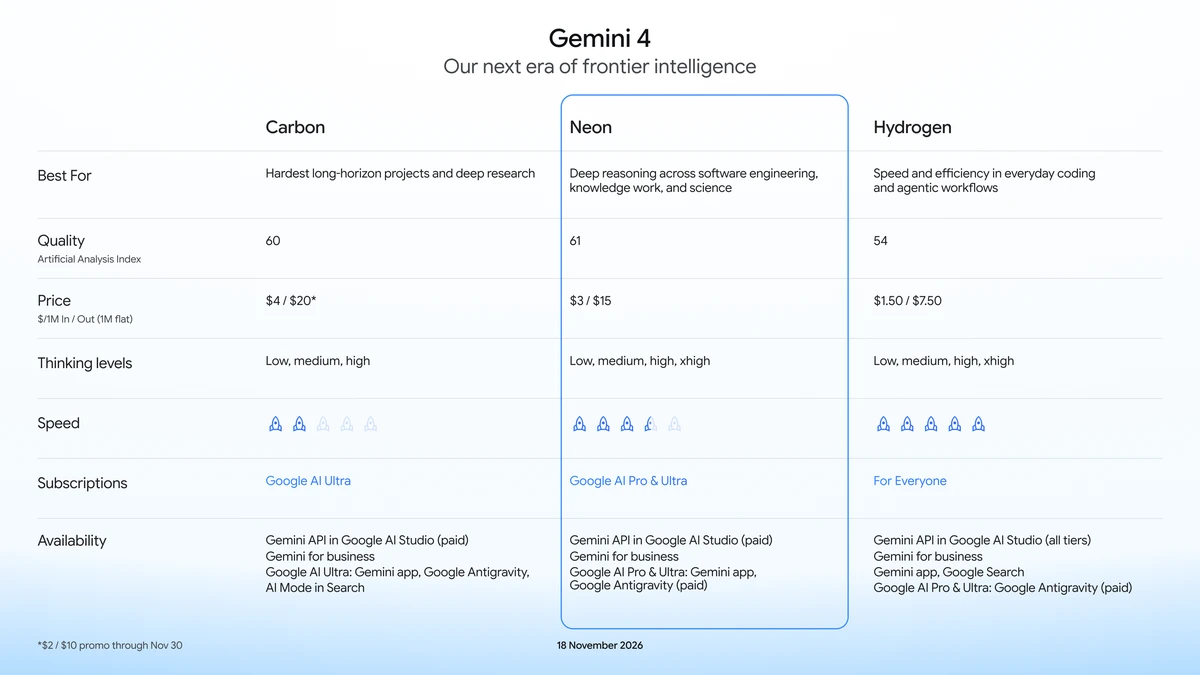
This is currently the clearest official side-by-side, but two caveats belong with it. First, it only covers the three models Google is currently featuring, not Argon. Second, don't treat the Artificial Analysis scores on the chart as a strict ranking; the next section explains why. For prices and thinking levels, I used the Gemini API pricing and choosing-a-model pages as they stood on November 22, 2026:
- Hydrogen (
gemini-4-hydrogen): Fast. Thinking levels are low, medium, high (default), and xhigh. Paid price is $1.50 per million input tokens and $7.50 per million output tokens, with caching at $0.075; a free tier is also available. It's available on every AI Studio plan and to all Search users. In the Gemini app, free users are auto-routed to it when it's a good fit; Antigravity requires a paid Pro or Ultra plan. - Neon (
gemini-4-neon): Moderate speed. Thinking levels also go up to xhigh, with high as the default. $3 per million input tokens and $15 per million output tokens, with caching at $0.15, and no introductory discount. The Gemini app and Antigravity require Pro or Ultra; the paid API is available. Google Cloud documentation says it is available to verified enterprise customers in select regions. - Carbon (
gemini-4-carbon): Slower and more deliberate. Thinking levels are low, medium (default), and high; there is no xhigh. Introductory pricing runs through November 30: $2 per million input tokens and $10 per million output tokens, with caching at $0.10. From December 1, that becomes $4 / $20, with caching at $0.20. It's aimed mainly at Ultra and paying developers; Cloud has the same regional and verified-enterprise limits. - Argon (
gemini-4-argon): The same thinking levels as Carbon, also with no xhigh, and the same price and introductory window as Carbon. Officially, it's described as a frontier model that uses fewer tokens than Carbon, and it's still in the catalog.
The knowledge cutoff for all of them is March 2026. The default synchronous output cap is 64,000 tokens; to go beyond that, you need to turn on long decode and raise the output limit, up to whatever remains of the unified 1 million-token window after your input. Output billing includes thinking tokens, so turning thinking up to xhigh will raise both the bill and the wait. Also, the current choosing-a-model page features Hydrogen, Neon, and Carbon in its general-purpose comparison; Argon still appears in the full model catalog and on the pricing page, but it is no longer presented as the default starting point.
One more easy mistake: the price per token is not the same as the cost per task. Neon costs more per token than Carbon's introductory rate, but the official Neon blog says that at the default high setting, Neon's cost per task is 32% lower than Carbon's. When you pick a model, look at the sticker price and at how long it will "think" by default.
Scores are useful, but don't rank them directly
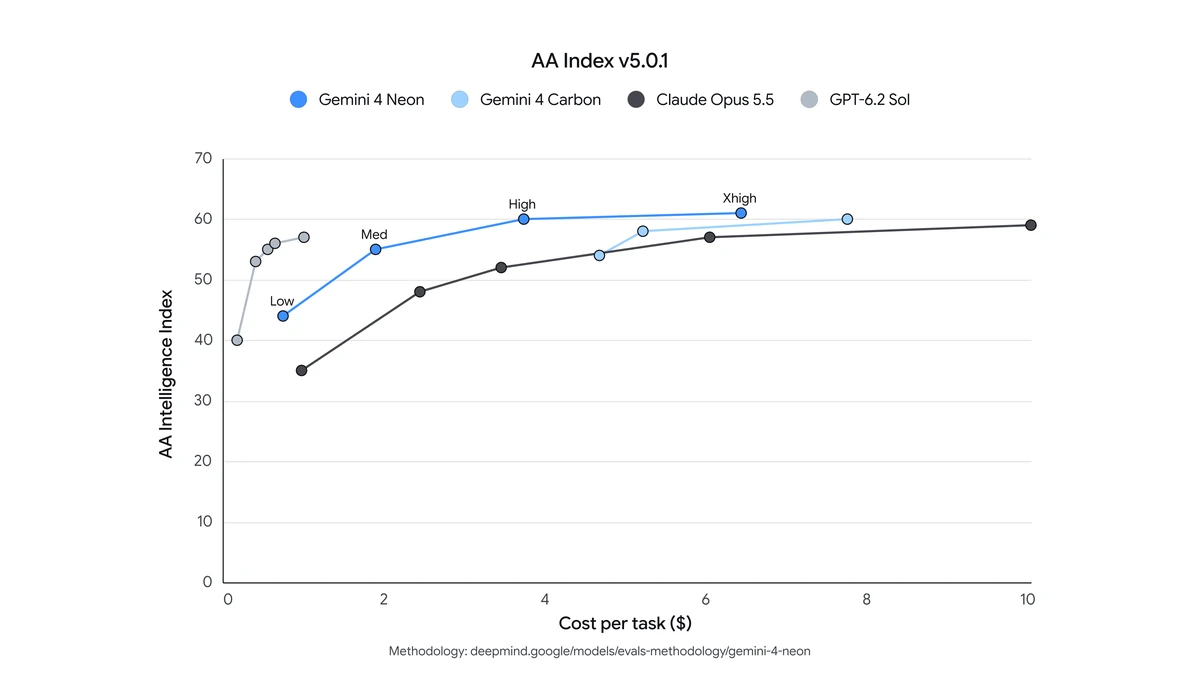
Even from the same company and the same index, the numbers can't be subtracted from each other once the conditions change. Carbon's model card reports an AA Index v5.0 score of 59, and Argon 50, with results as of October 2026. The official Hydrogen blog says 51 at default high and 54 at xhigh, which is above Argon's 50, but that does not make Hydrogen a full flagship. The official Neon blog says the index is 61 at xhigh, good for 3rd overall; the model card labels that as v5.0.1. On the November 18 family chart above, Carbon is listed as 60 and Hydrogen as 54—which is not the same table as the 59 on Carbon's model card, and that row doesn't specify a thinking level. So don't subtract 61 from 59, or from 60, and conclude that Neon has comprehensively overtaken Carbon.
Other scores also depend on the test setup. On Neon's model card, SWE-sweep is 39.0% on the provider harness and only 12.8% on mini-SWE, which shows how much the tools and environment matter. On FrontierCode 2.0, Google reports Neon at 46.2% at default high, versus 47.3% for Claude Opus 5.5 on the same table; a single benchmark doesn't settle it. Carbon's model card also notes that security-related scores such as SEC-bench Pro, ExploitGym, and CWE-bench were measured under Fairwind secure-access conditions.
How to choose in practice
For everyday choices, this is a useful starting point:
- Everyday coding, file edits, running agents, and keeping cost and latency in check: start with Hydrogen. If that isn't enough, raise thinking from the default high to xhigh; if that's still not enough, move up a model.
- Complex engineering, analysis, or science work where you're still waiting on the result: look at Neon. It goes deeper than Hydrogen, and it finishes faster than Carbon.
- Overnight debugging, security audits, or long verification loops: use Carbon. Google also says it spends more thinking tokens than Argon to explore and verify.
- If you already use Argon, and the work isn't hard enough to "test the limits of a model's intelligence": you can keep using it. You don't have to migrate just because a new name appeared.
Google also recommends tuning the thinking level before you switch to a larger model. On Hydrogen and Neon, xhigh can buy deeper reasoning, at the cost of more latency and more tokens. When you migrate from older models, the official choosing-a-model mapping is: if you were on Gemini 3.8 Flash, 3.6 Flash, or 2.5 Pro, start with Hydrogen; if you were on 3.1 Pro, start with Neon; for the hardest problems, go to Carbon. Don't mechanically rename them Flash, Pro, or Ultra; the names don't map one-to-one.
Pairing models is also an official recommendation: use Carbon or Neon for diagnosis and planning, and Hydrogen to write patches, run tests, and do parallel verification. Orchestrator in Antigravity switches models automatically in the same session. Google says that on Terminal-Bench 4.0 it reached near-Carbon success rates while using 24% less quota on average and finishing 19% faster. /swarm is also a scheduling feature, not a separate model.
The wording on the model cards is worth keeping as-is: Carbon is based on Argon, and Hydrogen and Neon are adapted from Carbon. Those are Google's own words. They don't, by themselves, prove distillation or any particular training method.
A few nearby names are not new general-purpose chat models. Carbon for cyber has the API ID gemini-4-carbon-cyber-permissive. It's available through Fairwind, defaults to the high thinking level, does not support computer use, and should not be treated as a fifth general model. There is also Argon Cyber Permissive. The Neon blog says Neon for cyber will roll out to trusted defenders through Fairwind; in the Cloud catalog and model-versions pages I checked, I did not find a public Neon cyber API ID, and I am not inventing one. Gemini Omni 1.2 Flash, released on November 5, is for video generation and editing; Gemini Decision 1, released on November 11, is for classification, routing, and scoring; and Genie 4, released on November 19, generates interactive worlds. None of these should be treated as a new tier of general-purpose Gemini 4 models.
The rumored Krypton
Some people in the community have been guessing that the next model might be called Krypton. As of November 22, 2026, I have not found a confirmed Gemini 4 Krypton product in Google's official blogs, the DeepMind model-card catalog, the AI Studio model list, pricing, or changelog, or the Cloud model catalog and versions pages. So it can only be described as a rumor: I can't say it is definitely about to launch, invent an API ID, capabilities, or a price, or assume it must be stronger than Carbon. Element names make it tempting to fill in the next box on the periodic table, but that is not an official claim.
The positioning, prices, and dates above follow the official pages linked in this article, as they stood on November 22, 2026. To check for yourself, start with the official blogs for Argon, the Carbon announcement, the Carbon launch, Hydrogen, and Neon, and with the DeepMind model cards.